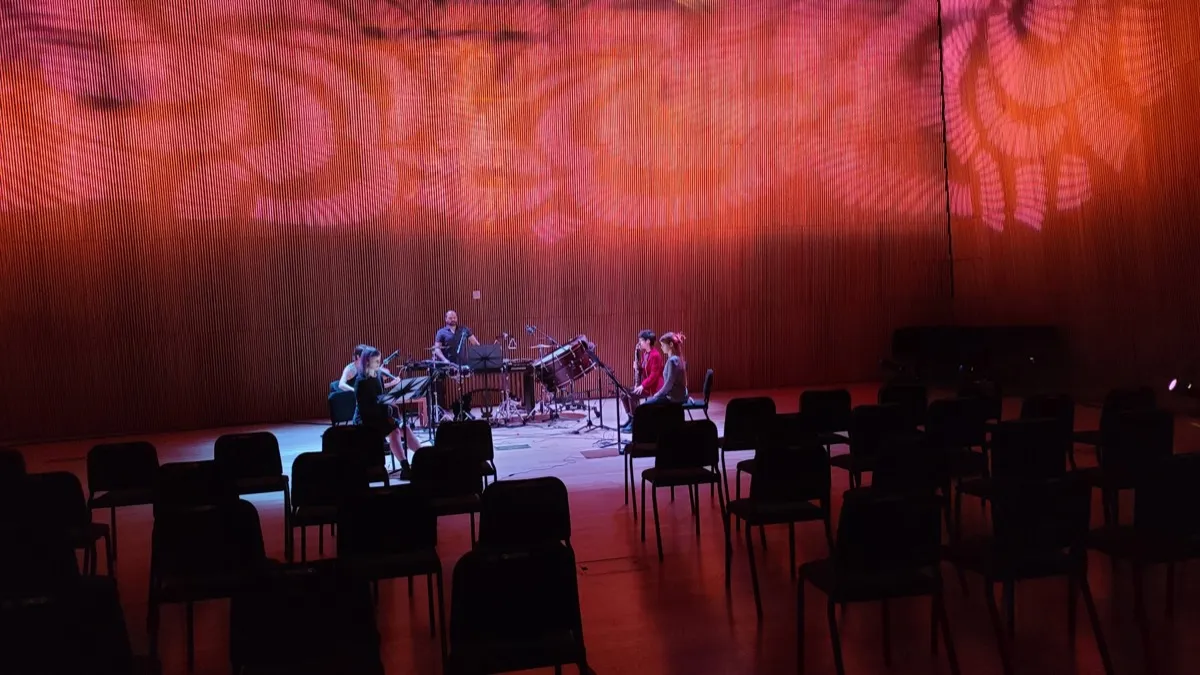
TAK ensemble, DiMenna Center, New York. Photo: Taylor Brook
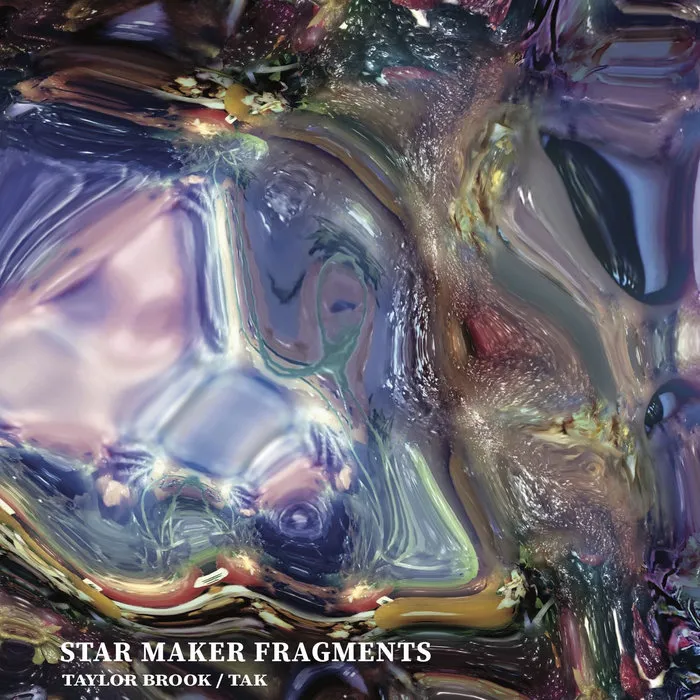
Star Maker Fragments
2020 · flute, clarinet, soprano, percussion, violin, and electronics
Duration: 45'
Chamber, Electronic
About Star Maker Suite
Star Maker Suite is an abbreviated version of Star Maker Fragments, which was written for TAK ensemble in the Summer 2019 to Spring 2020, setting text derived from the 1937 novel Star Maker by Olaf Stapledon. Star Maker Suite was completed for TAK ensemble for the Ukrainian Contemporary Music Festival, 2025. I am both grateful and humbled that this work will be premiered alongside Ukrainian composers in a great effort to counteract the legacies of cultural erasure and appropriation of Ukrainian Composers.
Star Maker Suite is approximately 25 minutes of continuous music with movements that flow seamlessly from one to the next:
- Introduction/Earth
- People of the Other World
- The Taste of God
- Musical Universes
- Back to Earth
This piece follows the journey of a person from earth who becomes disembodied and shoots out into the stars, first to observe other planets and their life forms and eventually understand the relationship between worlds, stars, and dimensions, before returning to earth and resuming their life with a renewed sense of meaning. The text for this piece was written on the eve of World War II and in many ways is allegorical, presenting a pacifist conception of society and the ideal of cooperation and empathy. The text is mostly spoken and the piece vacillates between concert music, electronics, and radio drama.
Star Maker Suite text:
note: Square Brackets are edits to the original text and ellipses mark where text is skipped over
- Introduction:
One night when I had tasted bitterness I went out on to the hill. Dark heather checked my feet. Below marched the suburban lamps. Windows, their curtains drawn, were shut eyes… Beyond the sea’s level darkness a lighthouse pulsed. Overhead, obscurity. I distinguished our own house, our islet in the tumultuous and bitter currents of the world. There, for a decade and a half, we two, so different in quality, had grown… into one another, for mutual support and nourishment, in intricate symbiosis. There daily we planned our… undertakings… recounted the day’s oddities and vexations. There the children were born, those sudden new lives. … Under that roof our own two lives… were… one larger, more conscious life…
…
Overhead obscurity was gone. From horizon to horizon the sky was an unbroken spread of stars.
…
On every side the middle distance was crowded with swarms and streams of stars.
…
The Earth was visibly shrinking into the distance … the planet had become an immense half-moon. Soon it was a misty, dwindling crescent.
- People of the Other World
I had always supposed that [humans are] unique being[s]. An inconceivably complex conjunction of circumstances had produced [them]… Yet here, on the very first globe to be explored…
…
His head I can best describe by saying that most of the brain-pan, covered with a green thatch, seemed to have slipped backwards and downwards over the nape. His two very human eyes peered from under the eaves of hair. An oddly projecting, almost spout-like mouth made him look as though he were whistling. Between the eyes, and rather above them, was a pair of great equine nostrils which were constantly in motion.
…
Civilization had reached a stage of growth much like that which was familiar to me. I was constantly surprised by the blend of similarity and difference…
…
There were empires, republics, dictatorships… also an underlying, deep-lying difference which I took long to understand… They responded with anger, fear, hate, tenderness, curiosity, and so on, much as we respond. In hearing… they were rather ill-equipped. Though their auditory organs were as sensitive as ours to faint sounds, they were poor discriminators. Music, such as we know, never developed in this world.
…
In compensation, scent and taste developed amazingly. These beings tasted not only with their mouths, but with then-moist black hands and with their feet… Taste played as important a part in their imagery and conception as sight in our own.
…
The genitals also were equipped with taste organs… These were savored faintly by contact of hands or feet with any part of the body, and with exquisite intensity in copulation.
…
Differences of race, which in our world are chiefly conceived in terms of bodily appearance, were for [them]… almost entirely differences of taste and smell… strife between groups whose flavors were repugnant to one another played a great part in history. Each race tended to believe that its own flavor was characteristic of all the finer mental qualities, was indeed an absolutely reliable label of spiritual worth…
…
In the more enlightened countries the whole racial superstition was becoming suspect. There was a movement among the intelligentsia for conditioning infants to [accept] every kind of human flavor… Unfortunately this movement of toleration was hampered by one of the consequences of industrialism. In the congested and unhealthy industrial centers a new gustatory and olfactory type had appeared… In a couple of generations this sour, astringent, and undisguisable flavor dominated in all the most disreputable working-class quarters. To the fastidious palates of the well-to-do it was overwhelmingly nauseating and terrifying… An unconscious symbol, tapping all the secret guilt and fear and hate…
…
Nearly all… production… [was] controlled for private profit by a small minority of the population [, forcing] the masses to work for them on pain of starvation… The owners directed the energy of the workers increasingly toward the production of more means of production rather than to the fulfilment of the needs of individual life… machinery might bring profit to the owners; [food] would not… Marketless products were destroyed… bellies were unfed… backs unclad.
…
the [pariahs] became more and more psychologically useful to the hate-needs [of the] powerful… The theory was spread that these wretched beings were the result of secret systematic race-pollution by riff-raff immigrants, and that they deserved no consideration… They were… allowed only the basest forms of employment and the harshest conditions of work. When unemployment had become a serious social problem, [the pariahs became] workless and destitute. It was of course easily believed that unemployment, far from being due to the decline of capitalism, was due to the worthless-ness of the pariahs… some politicians urged wholesale slaughter… or at least universal sterilization. Others pointed out that, as a supply of cheap labor was necessary… it would be wiser merely to keep their numbers down by working them to an early death… in times of decline, the excess population could be allowed to starve, or might be used up in… laboratories.
…
The persons who first dared to suggest this policy were scourged by the whips of generous popular indignation. But their policy was in fact adopted; not explicitly but by tacit consent…
…
Morning, noon and night… people were assured that enemies, whose flavor was of course subhuman and foul, were plotting [their] destruction. Armament scares, spy stories, accounts of the barbarous and sadistic behavior of neighboring peoples, created in every country such uncritical suspicion and hate that war became inevitable.
…
Of the horrors of this war, of the destruction of city after city, of the panic-stricken, starving hosts that swarmed into the open country, looting and killing, of the starvation and disease, of the disintegration of the social services, of the emergence of ruthless military dictatorships, of the steady or catastrophic decay of culture and of all decency and gentleness in personal relations, of this there is no need to speak…
- The Taste of God
… there had seldom been any widespread agreement as to the taste of God… Wars had been waged to decide whether [they were] in the main sweet or salt, or whether [their] preponderant flavor was one of the many gustatory characters which [humans] cannot conceive. Some teachers insisted that only the feet could taste [god], others only the hands, the mouth, others that [god] could be experienced only in a sensual, and mainly sexual, ecstasy induced by contemplation of intercourse with the deity.
…
Other teachers declared that, though God was indeed tasty, it was not through any bodily instrument but to the naked spirit that his essence was revealed… a flavor more subtle and delicious… it included all that was most fragrant and spiritual… and infinitely more.
…
Some went so far as to declare that God should be thought of not as a person at all but as actually being this flavor.
- Musical Universes
Many… early universes were non-spatial, though none the less physical… not a few were of the “musical” type, in which space was strangely represented by a dimension corresponding to musical pitch… with myriads of tonal differences. The creatures appeared to one another as complex patterns and rhythms of tonal characters. They could move their tonal bodies in the dimension of pitch, and sometimes in other dimensions, humanly inconceivable. A creature’s body was a more or less constant tonal pattern, with much the same degree of flexibility and minor changefulness as a human body. Also, it could traverse other living bodies in the pitch dimension much as [waves] on a pond may cross one another. … these beings could glide through one another, they could also grapple, and damage one another’s tonal tissues. Some… lived by devouring others… the more complex needed to integrate into their own vital patterns the simpler patterns… The intelligent creatures could manipulate for their own ends elements wrenched from the fixed tonal environment, thus constructing artifacts of tonal pattern… time was a more fundamental attribute than space. Though in some [time was excluded] embodying merely a static design.
…
Space… appeared first as a development of a non-spatial dimension in a “musical” cosmos. The tonal creatures in this cosmos could move not merely “up” and “down” the scale but “sideways.” In human music particular themes… approach or retreat, owing to variations of loudness and timbre. … the creatures in this “musical” cosmos could approach one another or retreat and finally vanish out of earshot. In passing “sideways” they traveled through continuously changing tonal environments.
…
There followed creations with spatial characters of several dimensions, creations Euclidean and non-Euclidean… exemplifying a great diversity of geometrical and physical principles…
- Back to Earth
I woke on the hill. The streetlamps of our suburb outshone the stars. The reverberation of the clock’s stroke was followed by eleven… more. I singled out our window. A surge… of wild joy, swept me like a wave. Then peace.
…
The littleness… the intensity, of this whole [earth]… its film of ocean and of air… my hand caressed the pleasant harshness of the heather.
…
The whole planet… with its busy swarms, I now saw as an arena where… two spirits were already preparing for a critical struggle…
…
It seemed that in the coming storm all the dearest things must be destroyed. All private happiness, all loving, all creative work in art, science, and philosophy, all… scrutiny and speculative imagination, and all creative social building; all, indeed, that [one] should… live for, seemed folly and mockery and mere self-indulgence in the presence of… calamity.
…
Our little glowing atom of community… the cold light of the stars… Strange that in this light, in which even the dearest love is frostily assessed, and even the possible defeat of our half-waking world is contemplated without remission of praise, the human crisis does not lose but gains significance. Strange that it seems more, not less, urgent…
Star Maker Fragments was written for TAK ensemble with electronics. This piece sets excerpts of Olaf Stapledon’s groundbreaking 1937 novel “Star Maker.”
This piece follows the journey of a person from earth who becomes disembodied and shoots out into the stars, first to observe other planets and their life forms and eventually understand the relationship between worlds, stars, and dimensions, before returning to earth and resuming their life with a renewed sense of meaning. The text for this piece was written on the eve of World War II and in many ways is allegorical, presenting a pacifist conception of society and the ideal of cooperation and empathy. The text is mostly spoken and the piece vacillates between concert music, electronics, and radio drama.
Laura Cocks - flute Madison Greenstone - clarinet Marina Kifferstein - violin Charlotte Mundy - voice Ellery Trafford - percussion Taylor Brook - electronics
Produced by Taylor Brook. Mastered by Chris Botta. Recorded by Ryan Streber at Oktaven Audio. Artwork by Lara Lewison. Design by Laura Cocks. Text excerpted from “Star Maker” by Olaf Stapledon.
Star Maker Fragments received its premiere concert performance on September 17, 2022, at the DiMenna Center for Classical Music, Cary Hall in New York City, performed by TAK ensemble with Taylor Brook realizing the live sound processing and diffusion.
Performances
- September 22, 2026 — Swarthout Recital Hall, Murphy Hall, Lawrence, KS — TAK Ensemble, Modney
- March 16, 2025 — CIRMMT-MMR, Semaine de Neuf, Montreal, QC — TAK Ensemble
- March 13, 2025 — Cary Hall, Ukrainian Contemporary Music Festival, New York, NY — TAK Ensemble
- September 17, 2022 — DiMenna Center, Cary Hall, New York, NY — TAK Ensemble