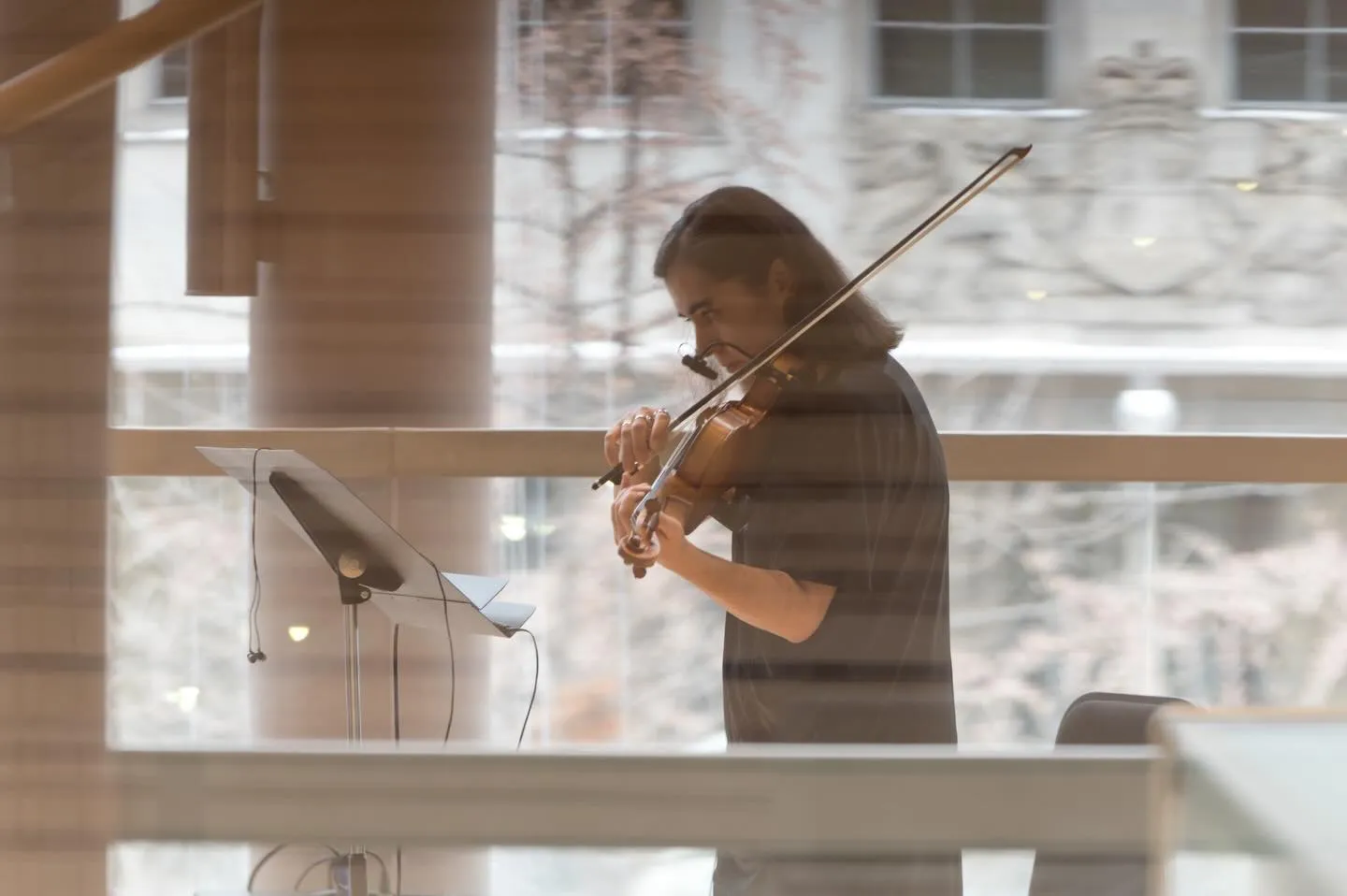
Aysel Taghi-Zada, Canadian Opera Company
Wane
2016 · solo violin with four pre-recorded violins
Duration: 12'
Solo, Electronic
Wane was written in fall 2015-Spring 2016 for Olivia De Prato.
Wane takes advantage of the multi-tracking possibilities of a recording session, where instead of a piece for a single solo violin, there is a lead soloistic part with four additional “shadow” violins, all of which are recorded by a single performer. While this piece finds an ideal form as a recording, it may also be performed live in two ways: playing the first violin line with prerecorded second through fifth violins, or with five violinists performing live.
Each of the five violin parts features a slightly different tuning and when the open strings of each violin are played in turn, one hears something like a downward slide. However, this slide or glissando effect is actually a smearing of discrete pitches that are extremely close together. This smearing effect provided the title of the piece, as the pitches seem to melt or wane.
While the tuning between the open strings of the violin parts is extremely close, they are all part of the same extended just intonation harmonic system that treats G as the tonic note. The importance of this systematic tuning is that all the pitches now have a double meaning: part of the downward smear effect as well as a harmonic identity. In practice, it need not be one or the other and the ambiguity between a smearing effect and a stable harmonic identity can be explored in interesting ways to suggest perceptual switches and surprising yet smooth chord changes.
Premiere: Olivia De Prato with Taylor Brook, conductor, Miller Theater, Columbia University, New York, June 12, 2019.
Download Score
Download Score (PDF)Performances
- February 3, 2026 — Canadian Opera Company, Toronto, ON — Aysel Taghi-Zada
- May 5, 2023 — Society Clubhouse, Toronto, ON — Aysel Taghi-Zada
- June 12, 2018 — Miller Theater, New York, NY — Olivia De Prato
- March 13, 2018 — Metropolis Ensemble, 1 Rivington St., New York, NY — Olivia De Prato