Performance Materials
Psychography (2026) · bassoon, piano, harp, vibraphone, 2 violins, viola, cello, double bass, electronics
Score & Parts
Each instrument has two parts: the part alone, and a version showing the tape staff beneath the instrumental line.
- Open
Full score PDF
- Open
Bassoon PDF
- Open
Bassoon + tape staff PDF
- Open
Piano PDF
- Open
Piano + tape staff PDF
- Open
Harp PDF
- Open
Harp + tape staff PDF
- Open
Vibraphone PDF
- Open
Vibraphone + tape staff PDF
- Open
Violin 1 PDF
- Open
Violin 1 + tape staff PDF
- Open
Violin 2 PDF
- Open
Violin 2 + tape staff PDF
- Open
Viola PDF
- Open
Viola + tape staff PDF
- Open
Cello PDF
- Open
Cello + tape staff PDF
- Open
Contrabass PDF
- Open
Contrabass + tape staff PDF
Practice Tracks
Excerpt tracks for rehearsing against the tape. Piano, harp, and vibraphone have no excerpt tracks — their full-length tape stems are in the Electronics section below.
Electronics
Playback assets for performance. The stems are large files — download them well ahead of the first rehearsal.
- Open
Logic session — psychography_performance Drive folder
Contains the Logic project and its Audio Files folder
- Open
Psychography_CLICK.wav WAV
176 MB — click begins at m. 6
- Open
Bassoon — tape stem WAV
166 MB
- Open
Piano — tape stem WAV
166 MB
- Open
Harp — tape stem WAV
166 MB
- Open
Vibraphone — tape stem WAV
166 MB
- Open
Violin 1 — tape stem WAV
166 MB
- Open
Violin 2 — tape stem WAV
166 MB
- Open
Viola — tape stem WAV
166 MB
- Open
Cello — tape stem WAV
166 MB
- Open
Contrabass — tape stem WAV
166 MB
- Open
Browse all materials in Google Drive Drive folder
Performance Notes
Microtonal notation
This work expresses microtones by way of cent deviation. A cent is a hundredth of a semitone. For example, a C with a +50 signifies playing the pitch a quartertone higher than the equal temperament C. This level of precision cannot be accurate to the exact cent, but for this particular piece the performers are almost always matching pitches heard in the electronics, that are playing to the cent. The microtones are almost entirely notes from an extended just intonation scale in the key of G.
Cent deviation appears up and to the left of the note, above the accidental or where the accidental would be in the case of a natural.
Tape Parts
For each instrument in the score there is a "tape" version that has the same timbre and blends with the live performer. Nearly all passages that demand precise microtones are doubled in these tape parts. It will be helpful to prepare individual parts while listening to the corresponding tape part and essential in rehearsal that these tape parts be clearly audible to the ensemble. The tape parts appear in the score underneath each instrument in a small staff. The musicians should try to blend with the tape parts as much as possible. For this reason, it's essential that the performers have a copy of the tape part to rehearse with as well as be able to hear their tape part in rehearsal and performance. This need to match pitch is one reason for the proximity of the speakers to the players; tape parts only come out of the speaker nearest the instrument.
Click Track
The click track begins at measure 6 and continues all the way through to the final measure.
About Psychography
Psychography was written for Turning Point Ensemble in the Spring and Summer of 2026.
“Psychography” refers to writing unconsciously, something that is often framed as channeling a spiritual force. For example, Hildegard von Bingen’s conviction that her writing was dictated by God positioned her as a conduit rather than an author. More recently, similar claims have been made by cult leaders, such as those associated with the famous UFO cult, the Seekers. Psychographic authors may truly believe they are merely a conduit or they may be positioning themselves strategically, but either way, this idea of psychography resonates with my own experience of how thought, reflection, and creativity happen.
Psychography mirrors an essential aspect of artistic creation: intuition. Across artistic disciplines, intuitive processes often exceed rational explanation, suggesting that all artists engage in forms of psychographic practice, as perhaps best exemplified by the mid-century Québécois artists Les Automatistes. The concept also intersects with how beliefs are formed and maintained. The case of cults illustrates how pre-existing convictions and cognitive dissonance shape perception and behaviour irrationally (the truth appeared! it just came to me and requires no proof or explanation!). In this piece, I use the concept of psychography as an entry point to explore intuition, belief, and perception as musical and aesthetic phenomena, informing the musical structures of the work, such as the tuning, form, harmony, and orchestration.
The clearest example can be found in the perceptual ambiguity between acoustic and electronic sound in this work. By placing speakers among the musicians that diffuse samples that mirror and blend with the acoustic instruments, the listener cannot fully determine the source of what they hear. This dislocation enacts the psychographic experience: the uncertainty of where sound originates as the music moves between what is possible and impossible for an acoustic instrument to play.
Questions about setup, or need materials sooner? Get in touch.
Stage plot
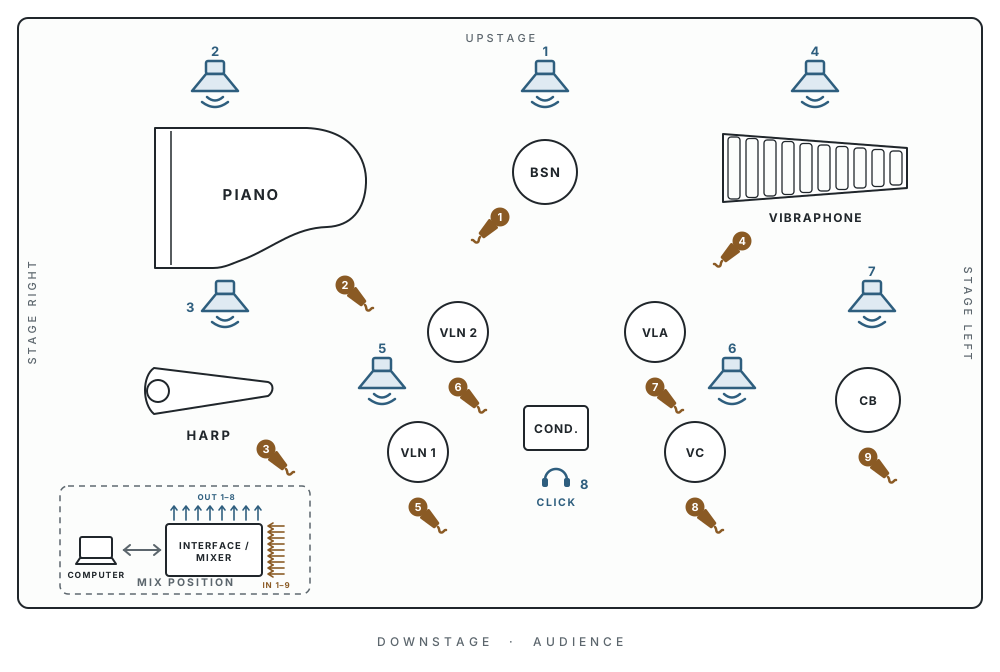
Stage plot — instrument, microphone, and loudspeaker positions.